
.svg)

August is supposed to be the quiet month as fund managers and politicians disappear to their holiday homes and markets gently drift along on low volumes.
For much of the month, hopes of progress in the Middle East helped oil prices retreat before events reverted to their 2026 default: renewed fighting. US strikes on Iranian positions on Larak Island prompted retaliation and Brent crude finished August back above $90. Six months into the conflict, perhaps the surprise is that anyone still expects a ceasefire to hold.
Kevin Warsh used his first Jackson Hole speech as Federal Reserve Chair to warn that the Fed still has work to do if inflation fails to return towards its 2% target. Markets responded by sharply increasing the probability of a September rate rise. With US employment softening, the Fed now faces the uncomfortable combination of sticky inflation and slowing growth.
The Bank of England faces a similar dilemma, while in China the problem is growth rather than inflation, with exports and technology compensating for weak domestic demand and property.
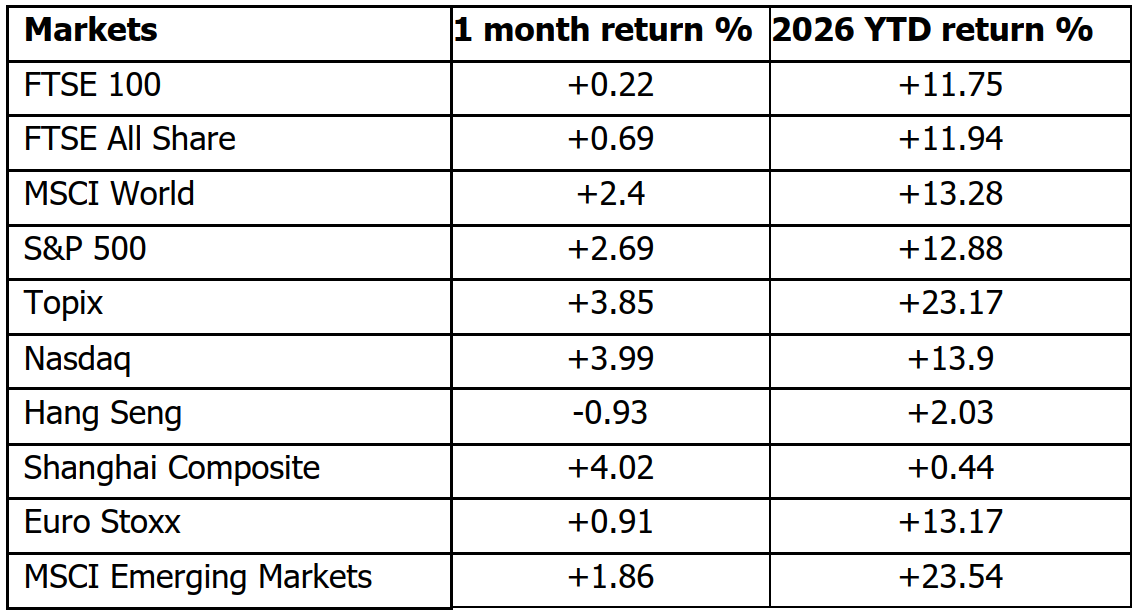
War, sticky inflation and rising bond yields ought to have been a toxic cocktail for markets. Instead, equities remained remarkably resilient.
The S&P 500 gained 2.7% during August and the Nasdaq 4.2%, as investors returned to technology shares.
Gold also had a strong month as concerns over inflation, government borrowing and geopolitical risk continued to support the so-called currency debasement trade.
Oil was volatile but ultimately went almost nowhere, with Brent ending the month back above $90 a barrel following renewed US-Iran fighting.
But perhaps the most important market to watch as we approach autumn is bonds.
Bonds may not be terribly exciting, but they influence the price of almost everything else. As government bond yields rise, investors can earn increasingly attractive returns without taking equity risk. Higher interest rates also make profits expected many years into the future worth less today — particularly relevant to highly valued growth and technology companies.
Government borrowing, stubborn inflation and renewed pressure on energy prices are making investors demand higher returns to lend governments money. During August, the US 30-year Treasury yield climbed above 5%, reaching its highest level since 2007, while borrowing costs also rose sharply in the UK, Europe and Japan.
Looking ahead – September has historically been the weakest month for US equities so we shouldn’t be too surprised by any increased volatility. For the moment, equity investors remain remarkably sanguine, but with bonds offering increasingly respectable returns, equities cannot ignore the competition indefinitely. It is interesting to note that after more than a decade of cheap money following the Global Financial Crisis , the current 10 and 30 year Treasury bond yields are back to their average in the 10 years prior to 2008.
Monthly performance figures 31/7/26 to 31/8/26 source FE Analytics. N.b. the fund sectors exclude money market funds, markets are in local currency, and investment trusts exclude VCTs.
Important Information
This document is produced by Fairview Investing Ltd, an independent research consultancy in conjunction with James Scott-Hopkins. The content is for information purposes only and does not constitute financial advice. The commentary or research provided do not constitute a personal recommendation to deal. Any statements, opinions, forecasts, and figures are made by Fairview Investing (unless otherwise stated). They are considered to be reliable at the time of writing but may be subject to change.
Fairview Investing accepts no legal responsibility or liability for the content of this material. The contents of the document are not to be re-produced or circulated without the express permission of Fairview Investing Ltd. Fairview are independent investment consultants sitting on the Investment Committee of EXE Capital Management.

EXE Capital Management is a trading style of Everys Financial Services Ltd., an investment firm authorised and regulated by the Financial Conduct Authority, Firm Reference Number 998644.
Registered Office & Correspondence Address: 3 Priory Court, Priory Estate, Poulton, Cirencester, Gloucestershire, GL7 5JB.
Registered Company Number 14819837. VAT 459 9391 29.
+44 (0)1285 283 800
enquiries@execapman.com
Privacy Policy