
.svg)

With no end in sight to the seven-month US-Israeli war with Iran, September was dominated by the economic consequences of high energy prices. Renewed US-Iranian strikes pushed oil back above $100 a barrel, while hopes of restoring flows through the Strait of Hormuz faded after President Trump rejected an Iranian proposal to reopen it within seven days.
The inflationary impact is becoming harder to ignore. UK diesel reached £2 a litre, while inflation stood at 3.4% in the US, 3.1% in the UK and 3.2% in the Euro area. The Federal Reserve responded by raising rates by 0.25% to 3.75%–4%, its first increase since 2023, while the ECB and Bank of Japan also tightened policy. The Bank of England held rates, although three members voted for an increase.
Bond markets bore the brunt of changing expectations. Ten-year US Treasury yields rose from 4.74% to 5.28%, gilts from 5.14% to 5.42%, while Japanese ten-year yields reached 3%. Heavy government borrowing added to the pressure, leaving investors increasingly focused on the ability of governments to keep their finances under control.
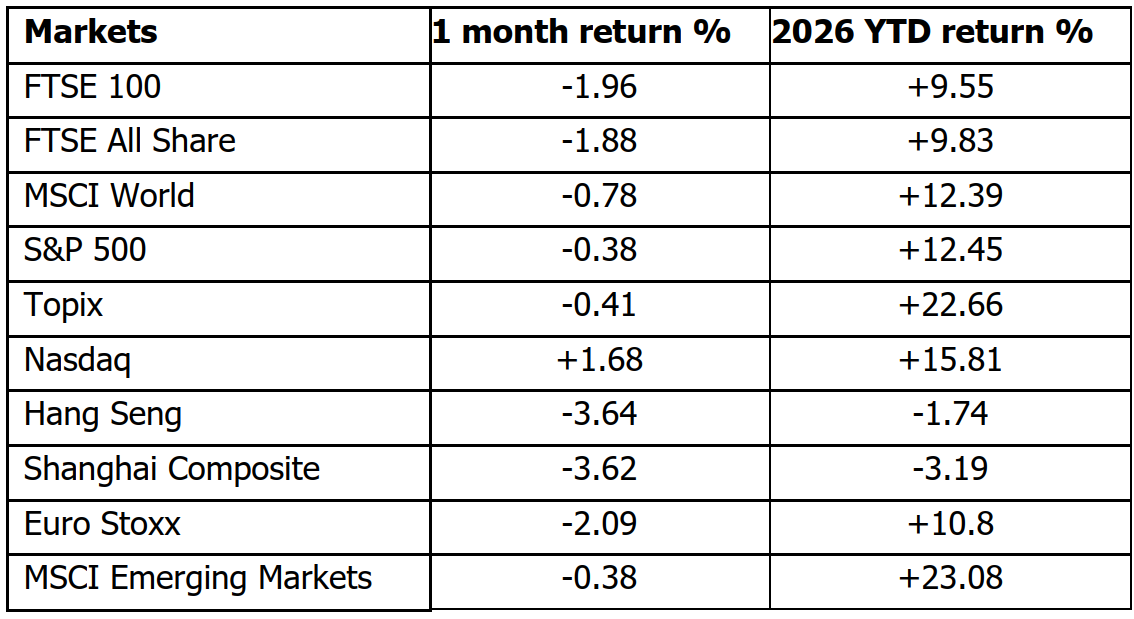
Meanwhile, equity markets, however, proved surprisingly resilient with the MSCI World falling just 0.8%. Having risen sharply in August, Gold fell almost $300 to $4,186 an ounce as higher real yields and a stronger dollar reduced its appeal, while sterling lost more than 2% against the dollar and 3.7% against the yen.
I thought I would share an interesting summary provided by Allianz Global Investors, managers of the Brunner Investment Trust that we hold on our preferred list. In their view, the global outlook has brightened. Despite persistent headwinds and above target inflation, companies are adjusting to higher rates, (you could argue back to normal following the Global Financial Crisis and Covid,) whilst central banks stay focused on inflation. Earnings are strong, supported by investment and AI spending, which should sustain, for now, momentum for both equites and bonds. Bond yields are moving higher, but given the scale of the energy driven inflation, the adjustment seems orderly. Higher rates may favour cash generating businesses and value stocks.
They conclude that overall, the backdrop remains constructive for risk assets. With Sovereign bonds declining in value as yields have risen, they now believe that US Treasuries and Japanese and UK government bonds are undervalued. The same is true of several equity markets led by emerging markets, that have repriced to a level where prices are either undervalued or trading at fair value and providing opportunities for active managers.
Monthly performance figures 31/8/26 to 30/9/26 source FE Analytics. N.b. the fund sectors exclude money market funds, markets are in local currency, and investment trusts exclude VCTs.
Important Information
This document is produced by EXE Capital Management in conjunction with Fairview Investing Ltd, an independent research consultancy. The content is for information purposes only and does not constitute financial advice. The commentary or research provided do not constitute a personal recommendation to deal. Any statements, opinions, forecasts, and figures are those of the authors at the time of writing but may not be appropriate for your individual portfolio and may be subject to change. Advice should be sought from your financial adviser.
Fairview are independent investment consultants sitting on the Investment Committee of EXE Capital Management.
The above does not constitute a recommendation to buy specific funds or assets. The value of investments can fall as well as rise. Past performance is no guarantee of future returns.

EXE Capital Management is a trading style of Everys Financial Services Ltd., an investment firm authorised and regulated by the Financial Conduct Authority, Firm Reference Number 998644.
Registered Office & Correspondence Address: 3 Priory Court, Priory Estate, Poulton, Cirencester, Gloucestershire, GL7 5JB.
Registered Company Number 14819837. VAT 459 9391 29.
+44 (0)1285 283 800
enquiries@execapman.com
Privacy Policy