
.svg)

It will come as no surprise that April has been dominated by the ongoing conflict in the Middle East, which is now entering its third month. The month started in a positive vein with US, Israel and Iran agreeing to a ceasefire whilst the parties underwent negotiations to try and find some common ground. But April finished with the conflict in stalemate with U.S. - Iran talks having stalled and operation 'Epic Fury' in danger of becoming an epic failure. With a hardline Iranian regime still in place and showing no signs of giving up their nuclear capability, the US is currently blockading the Straits of Hormuz, cutting off both trade to the west, but also vital petrol dollars to Iran. In addition, with no oil flowing it’s estimated that Iran’s oil storage facilities are almost full meaning the next step is capping oil wells. Does the IRGC care the long-term damage this will cause to the Iranian economy? Trying to predict Trump’s next move feels equally futile although he may be keen to achieve some sort of fudged resolution before his scheduled China summit with Xi Jinping in mid-May.
It’s debatable what the biggest news was last month but arguably it was the UAE abruptly leaving OPEC, the oil cartel that has ruled the roost for decades. Once this Iran conflict has ended will this suddenly mean a glut of oil? Will others follow suit? At the moment it’s largely a moot point as little oil is flowing from the Middle East!
With elevated oil prices increasing inflationary pressures Central banks continued to take a watching brief and although there were no changes in interest rates, the rhetoric has become increasingly hawkish. The Bank of England voted 8-1 to hold rates at 3.75% (bizarrely the Chief economist voted to increase rates despite near non-existent growth), and Governor Andrew Bailey said he couldn’t give any “cast iron assurance” that there would not be a rate rise. In the US, Jerome Powell has been replaced as Governor of the Federal Reserve by Kevin Warsh who is seen as being more sympathetic to Trump’s desire for low interest rates. However, despite the change in leadership, traders are not pricing in any cuts in US rates by this year given inflationary pressures. The Bank of Japan and the ECB held rates, but both Central banks signalled a June rate rise could be on the cards.
With geopolitical tensions casting gloom on the global economy, investors would be forgiven for expecting the worst; but it’s amazing how strong stockmarkets have been when you consider that oil has doubled in price over the last two months and that global trade through the Middle East has ground to a halt. Remarkably US stocks have had their best month since 2020 as investors bet the AI boom will deliver huge earnings for America’s technology hyperscalers. The resilience of stockmarkets has once again highlighted the futility of short-term market timing and letting fear from geopolitics dictate your investment strategy.
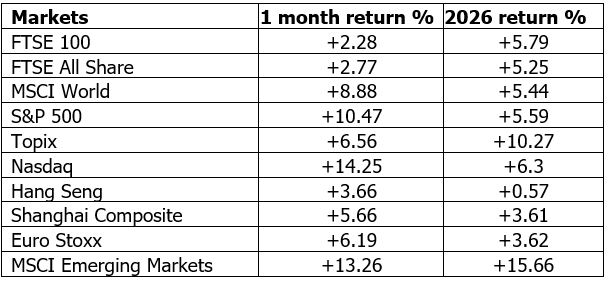
Following the sharp correction in March, stockmarkets bounced sharply in April, feeling unnaturally buoyant. Even as the optimism of a swift resolution to the conflict began to fade, the focus on strong corporate results in many areas, (particularly banks, technology companies, and oil), helped sustain the bounce back and the MSCI World index posted a gain of 8.8%.
US technology stocks were at the forefront of the rally driven by the unabated boom in AI. The S&P 500 rallied 10.4% and tech heavy NASDAQ rose 14.2% on the back of generally positive first-quarter earnings from the tech giants. Google parent Alphabet, Apple, Amazon and Microsoft impressed analysts but Meta was an outlier with concerns over their AI spending.
AI focused stocks also pushed Asian markets higher and saw Japan’s Topix up 6.6% and pushed Taiwan and South Korea to record highs (the latter overtook the UK to become the 8th largest global market despite being half the size of the UK at the beginning of 2024!). The UK’s FTSE All Share was up 2.3% in April and is up a creditable 5.8% so far in 2026 despite not having a large tech presence to join in on the AI fuelled party.
Bond markets have remained volatile in April spooked by inflationary pressures. In the US, yields continued to climb and the ten-year treasury now pays 4.37% after offering 4.32% a month ago. In Japan, the move has been sharper with the ten-year JGB rising from 2.35% to 2.52% with a rate rise in June on the cards. In the UK gilts remain out of favour despite Government borrowing hitting a four year low in March. The ten-year gilt finished April at 5.01% up from 4.91% at the beginning of the month - not a huge move but going through the 5% level is symbolic.
Turning to commodities and Oil continues to be the key barometer for global markets. Daily swings of $10 a barrel have become commonplace often in response to Donald Trump’s social media posts. April started with a barrel of Brent crude costing $103 and ended at $110.
Movements in the gold price have been more subdued following recent volatility and felt much more range bound in April. Gold finished yesterday costing $4629 an ounce compared to $4698 at the end of March. Silver behaved similarly falling from $75 to $73.74.
In currency markets, the pound rallied rising 1% against the Euro and 2.6% against the dollar which gave up some of its recent gains. The Japanese Yen finished 1.16% down in April versus sterling despite the Bank of Japan supposedly intervening to prop the weak currency up, The Brazilian Real was arguably the standout currency last month gaining 1.51% versus the pound.
Monthly performance figures 31/3/26 to 30/4/26 source FE Analytics.
N.b. the fund sectors exclude money market funds, markets are in local currency, and investment trusts exclude VCTs.
Important Information
This document is produced by Fairview Investing Ltd, an independent research consultancy. The content is for information purposes only and does not constitute financial advice. The commentary or research provided do not constitute a personal recommendation to deal. Any statements, opinions, forecasts, and figures are made by Fairview Investing (unless otherwise stated). They are considered to be reliable at the time of writing but may be subject to change.
Fairview Investing accepts no legal responsibility or liability for the content of this material. The contents of the document are not to be re-produced or circulated without the express permission of Fairview Investing Ltd. Fairview are independent investment consultants sitting on the Investment Committee of EXE Capital Management.

EXE Capital Management is a trading style of Everys Financial Services Ltd., an investment firm authorised and regulated by the Financial Conduct Authority, Firm Reference Number 998644.
Registered Office & Correspondence Address: 3 Priory Court, Priory Estate, Poulton, Cirencester, Gloucestershire, GL7 5JB.
Registered Company Number 14819837. VAT 459 9391 29.
+44 (0)1285 283 800
enquiries@execapman.com
Privacy Policy